
Last updated November 17, 2026
 Furnace & heating
 Heat pumps
 Ductless mini splits
 Carrier
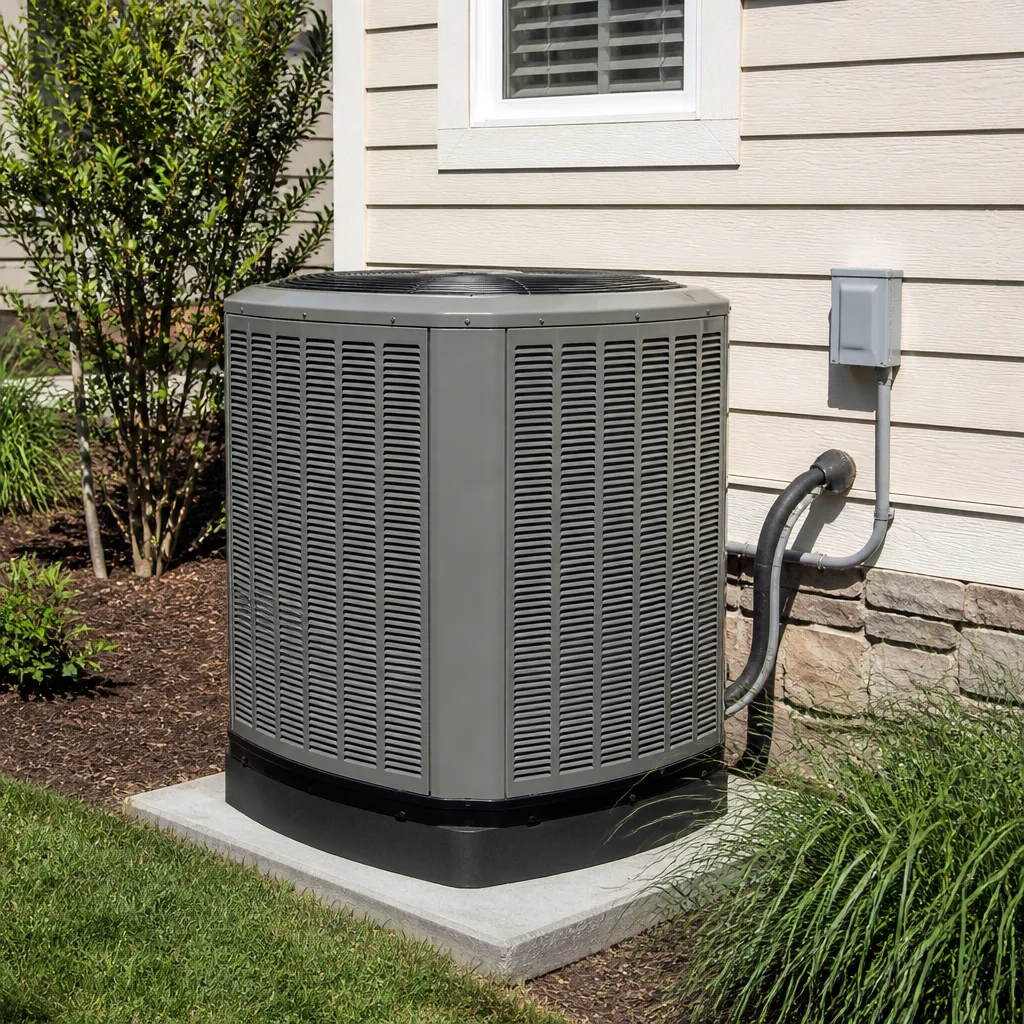 Trane
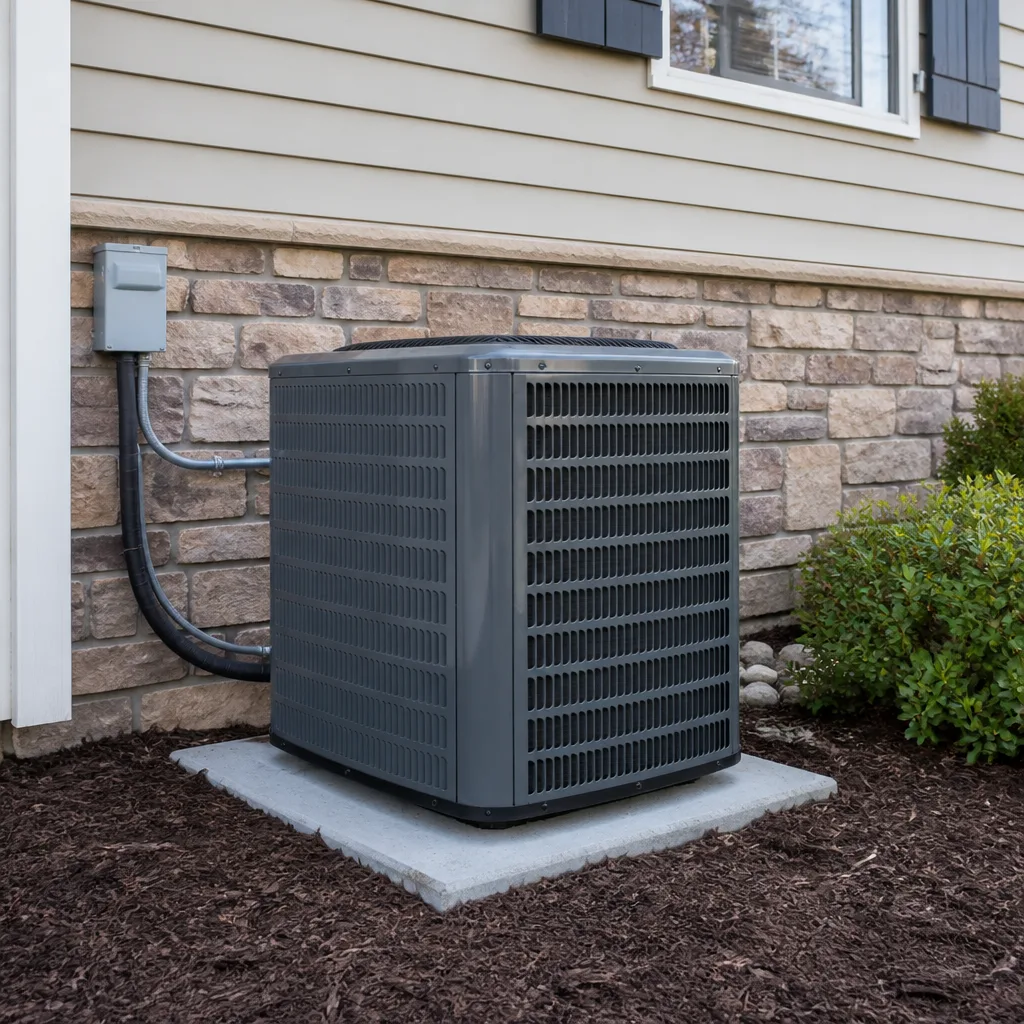 Goodman
Seasonal tune-up and full diagnostic on your Carrier, Trane, or Goodman system - readings shown to you before any repair is proposed
Diagnosis first, numbers second - you approve the repair price before a single part goes in.
Get your free estimateAC Repair Troubleshooting in Mesquite: Common Problems and How to Fix Them
If your AC is blowing warm air in Mesquite in July, the cause is almost never the same thing as when it happens in March. Operating pressure and ambient temperature change which component fails first, and diagnosing without that context wastes time and money. Most troubleshooting guides are organized alphabetically, by component, or by whatever fits on a refrigerator magnet. That’s not how a homeowner experiences a breakdown. You notice a sound, or warm air, or a unit that just won’t start. This guide works backward from what you actually observe and maps each symptom to the two or three most likely causes under Mesquite’s operating conditions. By the end you’ll know what you can safely check yourself, what should stay untouched, and what information makes a technician’s visit faster.
Quick Answer
If your AC isn’t cooling, the most common causes in Mesquite are a clogged air filter, a failed capacitor, low refrigerant from a leak, or a dirty condenser coil struggling against summer heat. Most of these need a technician to confirm, but a filter check and a thermostat check are safe to do yourself first. Shut the system off if you hear grinding or smell burning and call a professional for the rest.
Styles & brands we work with
- AC installation
- Furnace & heating
- Heat pumps
- Ductless mini splits
- Carrier
- Trane
- Goodman
Table of Contents
- Symptom One: The Air Is Warm or Barely Cool
- Symptom Two: The Unit Won’t Start At All
- Symptom Three: Unusual Sounds You Can Hear From Inside
- Symptom Four: Short Cycling in Peak Summer vs. Spring
- Symptom Five: Weak Airflow From the Vents
- Symptom Six: Water, Ice, or Dripping Around the Unit
- Symptom Seven: The Coil or Line Set Is Frozen
- What You Can Safely Check Before Calling
- Common Mistakes to Avoid
- When to Call a Professional
- Frequently Asked Questions
- The Bottom Line
Symptom One: The Air Is Warm or Barely Cool
Warm air is the complaint we hear most, and it splits into three distinct problems: refrigerant, airflow, or electrical. The tell is in how the system behaves when you listen. A unit that runs but produces no cooling at the vents is usually a refrigerant charge issue or a compressor that isn’t engaging. A unit that runs and produces some cooling but not enough is nearly always airflow – a clogged filter, blocked return, or a coil that’s coated in dust from another windblown week in the desert.
Refrigerant problems behave differently by season. In July, when outdoor temperatures sit well above 100°F, a system with a slow leak loses its charge mentally faster because the compressor works harder and pressures climb. In March, the same leak might still be delivering cool air – just not for long. That seasonal shift matters for diagnosis. What you call “it was working fine in spring” is often the same leak announcing itself later.
How to tell refrigerant from airflow
- Refrigerant leak signs: The unit runs, the fan blows, but the air is room temperature or warmer. You may see ice on the copper line set. The compressor may cycle off quickly on high-pressure protection.
- Airflow signs: The air is cool but weak. Some rooms don’t cool at all. The outdoor unit runs fine. Filters are dirty or the return grille is blocked.
- Electrical signs: The indoor blower doesn’t come on, or the compressor makes a click and hums without starting. This is often a capacitor on its way out.
Fixing this properly means knowing which of those you’re dealing with before you spend money. Our approach on any AC repair call starts with pressure readings and airflow verification, not guessing from the thermostat. If the system turns out to be beyond economical repair, we say so. Call (866) 764-5851 and describe what you’re seeing – warm air, weak air, or no air at all – and we’ll tell you what to check before we arrive.
Symptom Two: The Unit Won’t Start At All
A system that won’t start at all is a different diagnostic tree than one that runs but doesn’t cool. In our experience, the majority of no-start calls come down to one of five things, and three of them are checks a homeowner can perform in under ten minutes.
- The thermostat is off, on the wrong mode, or dead. Check that it’s set to “cool,” the setpoint is below room temperature, and the batteries aren’t dead. This sounds elementary, but it’s the single most common reason a “broken” AC isn’t broken.
- The breaker tripped. Check the electrical panel for a tripped breaker feeding the outdoor unit. If it trips again after reset, stop. Repeated breaker trips point to a failing compressor or a short, and that’s a technician’s job.
- The condensate float switch tripped. Most modern systems have a safety switch that shuts the unit down when the drain pan fills. A clogged condensate line in summer – common in Mesquite when humidity spikes after monsoon moisture moves through – will trip this. Clear the drain, then the system may restart.
- The capacitor failed. A bad run capacitor prevents the compressor or blower from starting. The unit will hum briefly then shut off. This is a technician repair; capacitors store voltage even after power is off.
- The contactor or control board failed. Less common, but it happens. These need testing with a meter and shouldn’t be touched by anyone untrained.
When the unit simply won’t run, the electrical panel and the safety switch are the two places a homeowner can look without risk. If both check out and the unit still won’t start, that’s when to call. Give us the symptoms when you call and we’ll come prepared. Our AC installation and repair technicians have up to 10 years of experience with the failure patterns these systems develop in desert heat.
Symptom Three: Unusual Sounds You Can Hear From Inside
Sounds are diagnostic gold. Each noise points to a specific component, and knowing which one saves diagnostic time on the visit.
- Clicking on and off in a rhythm: Usually a failing capacitor, a compressor under pressure stress, or a thermostat cycling prematurely. Clicking at regular intervals after startup often means the compressor is drawing too much current and the overload is protecting it.
- Buzzing: An electrical issue, a loose contactor, or a failing blower motor. Buzzing from the outdoor unit deserves attention because it can signal a contactor chattering or a loose connection.
- Squealing: Belt or blower bearing. Less common on modern units but still around in older systems.
- Grinding or scraping: Metal-on-metal. Shut the system off and call. This can indicate a failing fan motor bearing or a broken component touching the fan blade.
- Rattling: Loose panels, a fan blade imbalance, or debris against the outdoor unit. Check for loose screws and clear anything touching the cabinet, but leave the internals alone.
- Hissing: Refrigerant escaping from a leak, or air escaping a duct. If the hiss is continuous and near the outdoor unit, refrigerant is the more likely cause.
Any sound that persists after shutdown, or any smell of burning with it, gets a call. We answer 24/7. Fast dispatch from 7am to 7pm, Sunday through Friday. When you call, tell us the sound and roughly where you hear it – inside, at the outdoor unit, or at the vents – and that narrows the diagnosis before we arrive.
Symptom Four: Short Cycling in Peak Summer vs. Spring
Short cycling means the system turns on and off in short bursts instead of running in longer cycles. It’s one of the most misunderstood symptoms, because the cause depends entirely on the season and ambient temperature.
In peak summer (June through September in Mesquite)
Short cycling in extreme heat is usually a capacity or heat-rejection problem. The system can’t shed enough heat, pressure climbs, and the compressor shuts off on high-pressure protection. Root causes include:
- Low refrigerant (but less common as a short-cycling cause in peak heat)
- A dirty or blocked condenser coil outside – dust, cottonwood, or debris trapped against the fins
- Restricted airflow indoors from a dirty filter or blocked return
- An oversized system that cools too fast and shuts down before dehumidifying (a known issue in homes built for capacity, not climate)
- A failing high-pressure switch or overcharged system
In shoulder season (spring and fall)
Short cycling when temperatures are mild is almost always a low-charge or control problem. A system with a slow leak will short cycle when it’s cooler because it can’t maintain adequate suction pressure. A failing thermostat, a low-voltage wiring issue, or a faulty control board can also cause rapid cycling when the load is low.
What this means for you: if the problem shows up in March and disappears in June, that points to charge or control. If it shows up only in July, that points to heat rejection and airflow. Same symptom, entirely different fix. This is exactly the kind of seasonal pattern we account for when diagnosing in Mesquite.
One more note: short cycling accelerates wear. Each startup draws high current through the compressor and capacitor. A cycling problem left alone usually turns into a compressor failure – the most expensive AC repair there is. Don’t let it ride.
Symptom Five: Weak Airflow From the Vents
Weak airflow is the sneakiest of the symptoms because the system is technically running. It’s cooling, just not enough. Over time homeowners adjust the thermostat lower and lower, which masks the problem but never fixes it, and raises both the energy bill and the wear on the compressor.
The airflow chain runs from the return grille through the filter, through the blower, through the evaporator coil, into the ductwork, and out the registers. Any restriction anywhere in that chain causes the same result: weak air at the vents. The most common restriction points, in order of likelihood:
- The filter. A filter loaded with dust restricts air more than most people realize. In dusty conditions, filters clog much faster than the manufacturer’s replacement interval suggests. Change it, then re-test airflow at a register.
- The return grille. Furniture, rugs, or a closed door blocking the return starves the system. Check that every return is unobstructed.
- The evaporator coil. A coil coated with dust restricts airflow and also cripples cooling. You can’t see this from outside; it requires the technician to open the air handler.
- The ductwork. Leaky or disconnected duct runs dump cooled air into the attic or crawlspace. In many Mesquite homes, a partially disconnected duct in the attic is the reason one room never cools.
- The blower motor. A failing blower or a slipping belt reduces airflow. You may hear the motor running but get weak output.
Before calling, change the filter and clear every return. If airflow improves, you’ve likely solved it. If not, the next step is a technician check of the coil and ducts. When you call, tell us which rooms are weak and which are fine, and whether the outdoor unit is still running normally. That information alone narrows the diagnosis significantly.
Symptom Six: Water, Ice, or Dripping Around the Unit
Water where water shouldn’t be is one of the few symptoms that can damage the house if you ignore it. In desert climates where cooling season runs long, the condensate drain carries a lot of water. When it clogs, it backs up.
- Water dripping from the indoor unit or ceiling: A clogged condensate line or a full drain pan. The float switch should shut the system off before this becomes a ceiling stain, but float switches fail too. Clear the drain line if you can reach it safely, and shut the system off if water is actively dripping.
- Water pooling around the outdoor unit: Normal in small amounts during operation (condensate off the coil). A steady stream that doesn’t stop after the unit shuts off can indicate a refrigerant leak venting or a drainage issue.
- Ice on the indoor coil or copper line set: See the frozen coil section below. Ice is never normal.
If water is reaching drywall or carpet, shut the system down at the thermostat and call us. Water damage compounds fast, and a condensate overflow is one of the few AC problems that affects more than the equipment. We answer 24/7. Fast dispatch from 7am to 7pm, Sunday through Friday, and the earlier we get eyes on it, the smaller the repair.
Symptom Seven: The Coil or Line Set Is Frozen
A frozen evaporator coil or ice on the copper line set looks alarming and usually gets misdiagnosed as “the system is overcharged.” In our experience, ice is far more often the opposite: the system is undercharged or airflow is too low, so the coil gets cold enough to freeze condensate.
The three common causes of a frozen coil:
- Low refrigerant from a leak. Less charge means less pressure across the coil, colder coil temperatures, and ice buildup. This is the most common cause in a system that’s been running fine until recently.
- Restricted airflow. A dirty filter, a blocked return, or a dirty evaporator coil reduces airflow across the coil, causing it to freeze. Same ice, different cause.
- A failing blower motor. If the blower isn’t moving enough air, the coil freezes even with a correct charge.
What to do when you see ice: shut the system off at the thermostat and let it thaw completely before running it again. Don’t chip at the ice. Don’t turn the system back on to “see if it fixed itself” – if the underlying cause is still present, it will freeze again and you’ll drive the compressor harder each cycle. Once thawed, check the filter and returns. If the ice returns, call. Refrigerant handling is regulated and requires proper equipment, so this is a technician diagnosis.
What You Can Safely Check Before Calling
These checks are safe and meaningfully narrow the diagnosis before a technician arrives. We walk through this list with callers all the time, and when you’ve done it first, the visit is faster and the estimate is more accurate.
- Thermostat. Confirm mode is “cool,” setpoint is below room temperature, and the display is on. Replace batteries if applicable. Look for any error code on the screen and note it.
- Breaker panel. Verify both the indoor air handler breaker and the outdoor unit breaker are on. Note if one is tripped.
- Air filter. Pull it and hold it up to the light. If you can’t see light through it, replace it.
- Return grilles. Make sure every return is open and unobstructed. Furniture and rugs are common culprits.
- Condensate drain and pan. Look for standing water in the pan or water at the base of the air handler. If there’s water, shut off the system.
- Outdoor unit clearance. Make sure the outdoor unit has clearance around it and the coil fins aren’t packed with debris. You can rinse the fins gently from outside with a garden hose, power off first, but don’t bend the fins or open the cabinet.
- Visible ice. Note any ice on the copper lines or indoor coil. Shut off and thaw if present.
What you should not do: open electrical panels on the equipment (capacitors store lethal voltage even after power is off), handle refrigerant lines, or bypass the safety switches. Those are technician work, not homeowner work.
See the difference
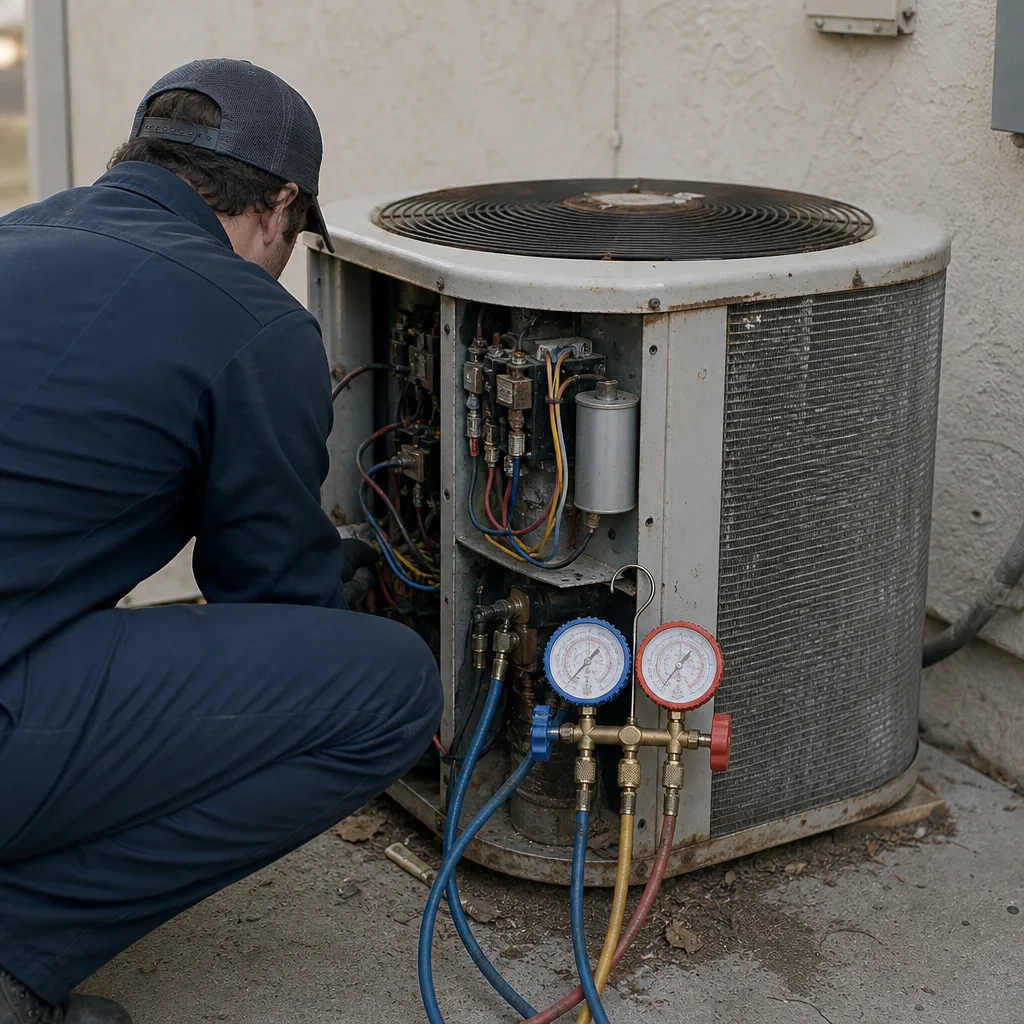 Before
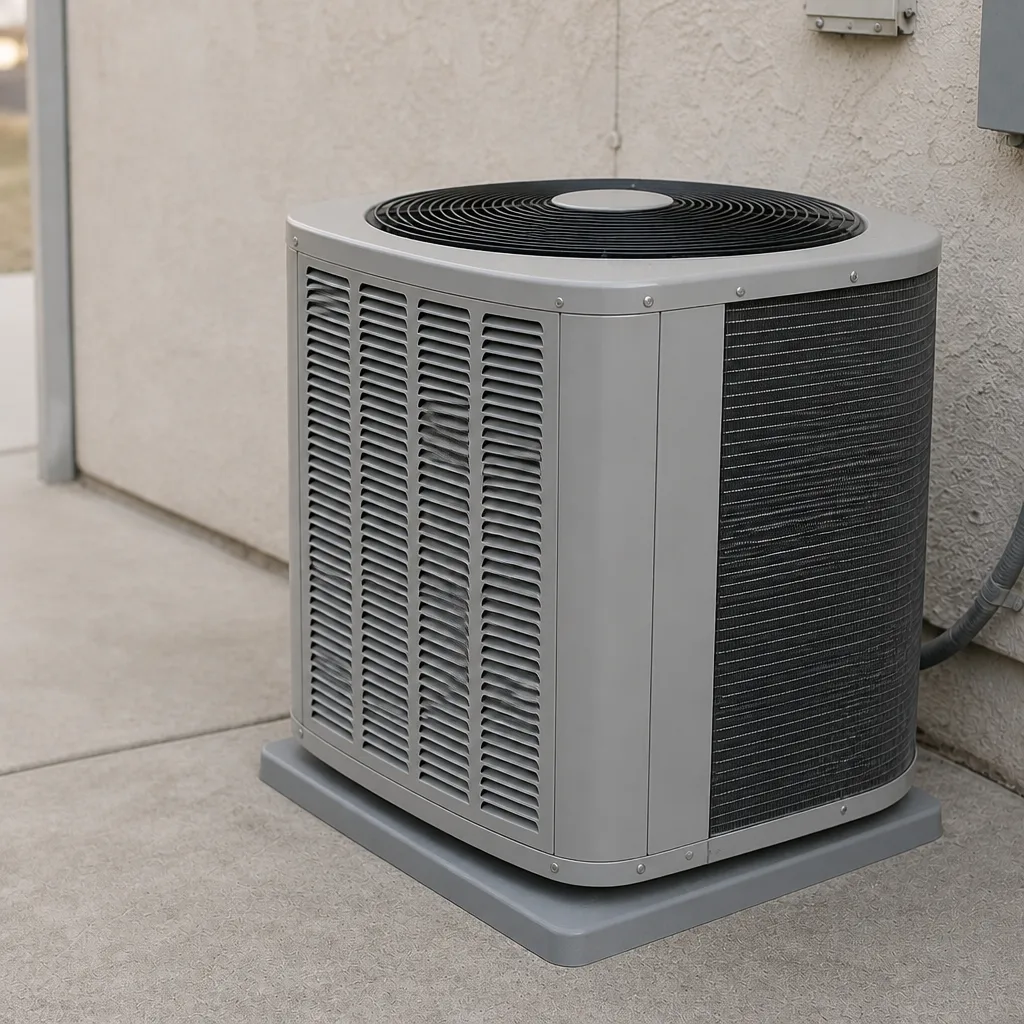 After
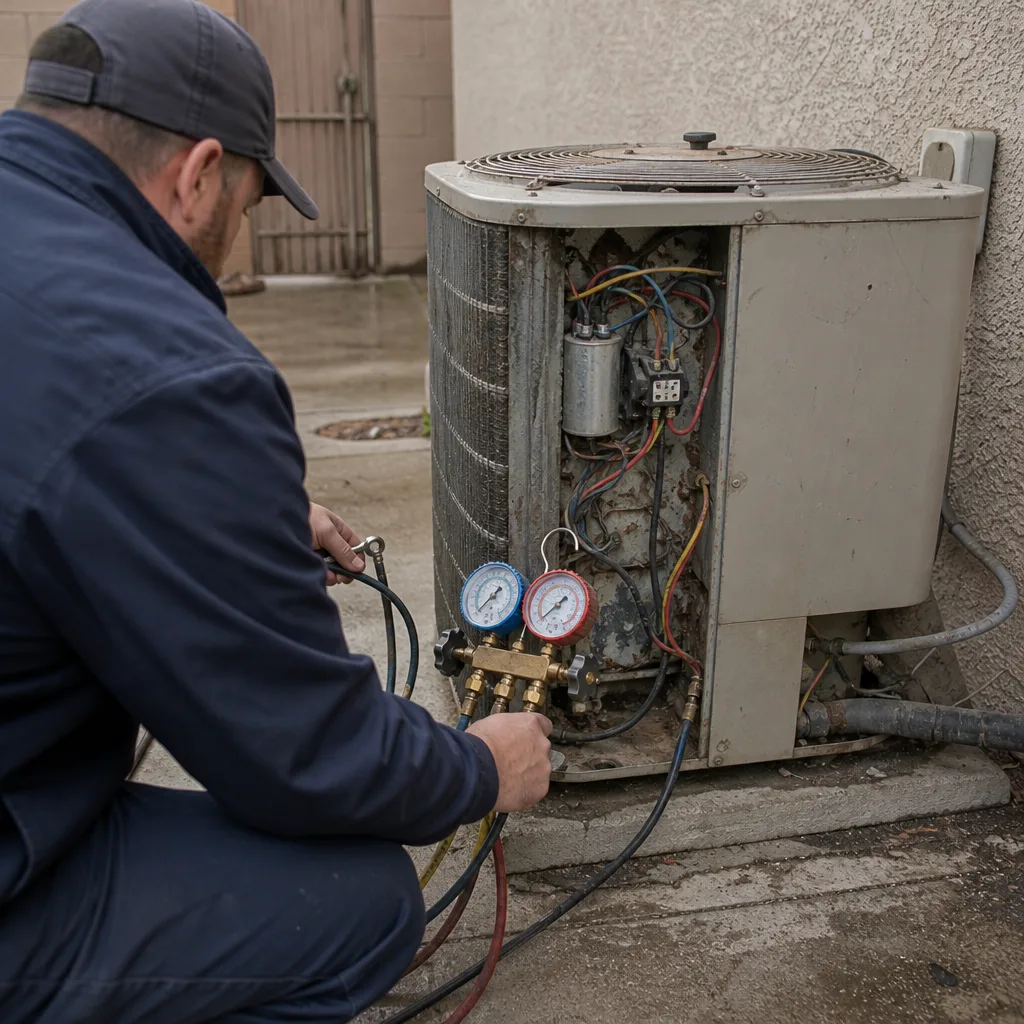 Before
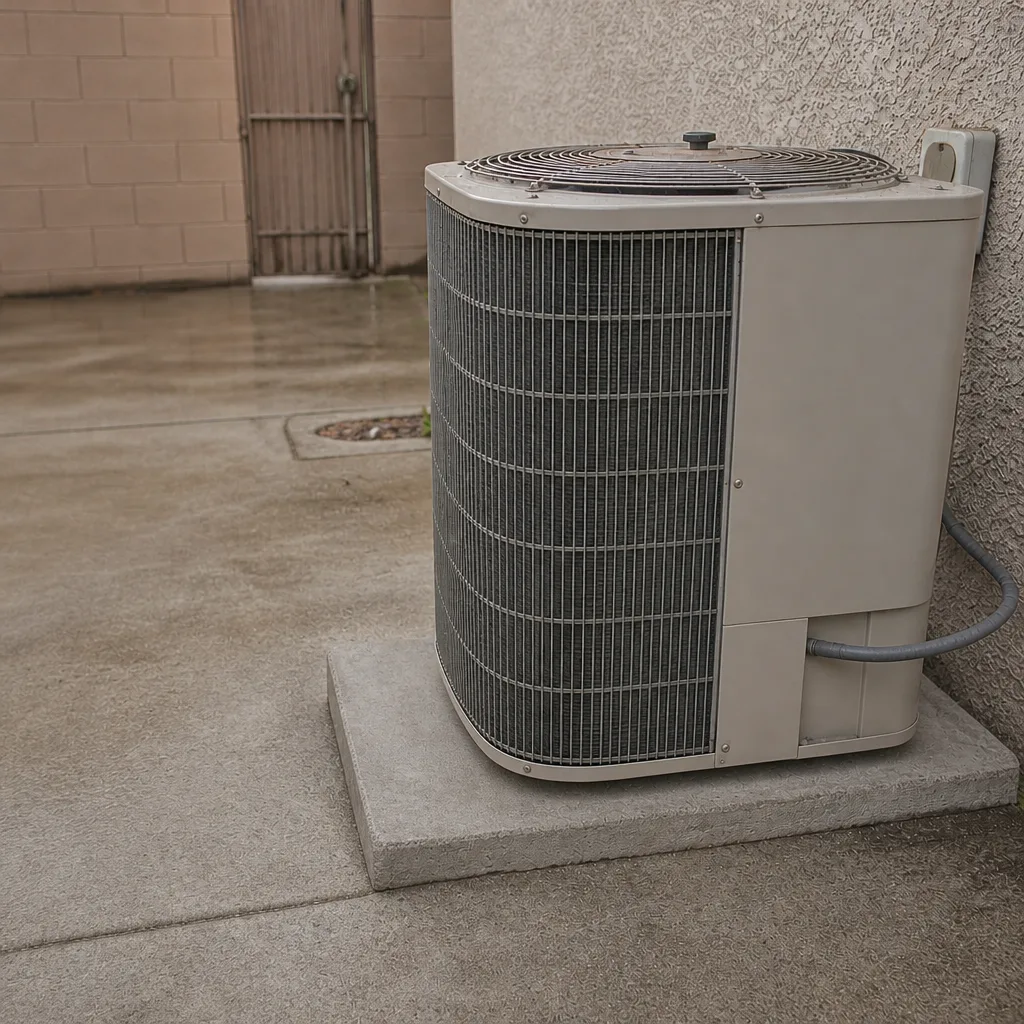 After
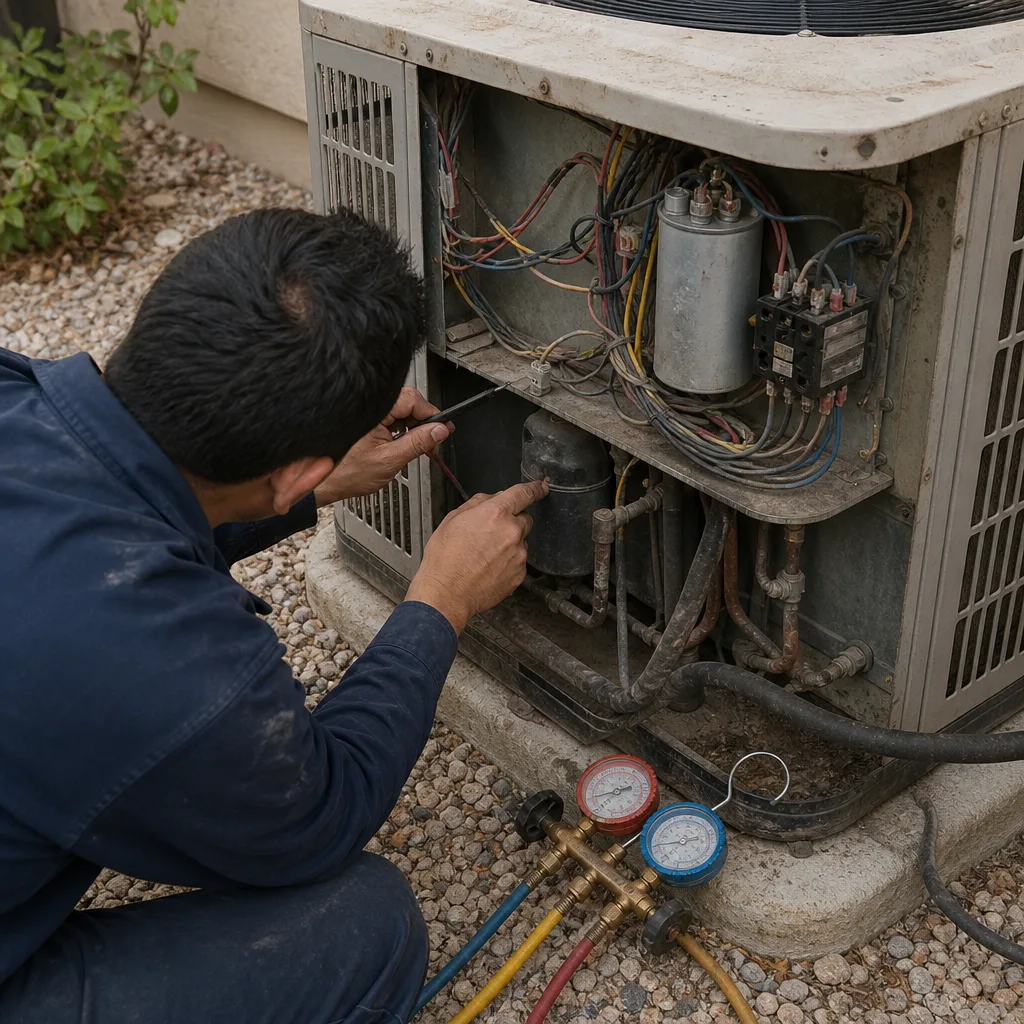 Before
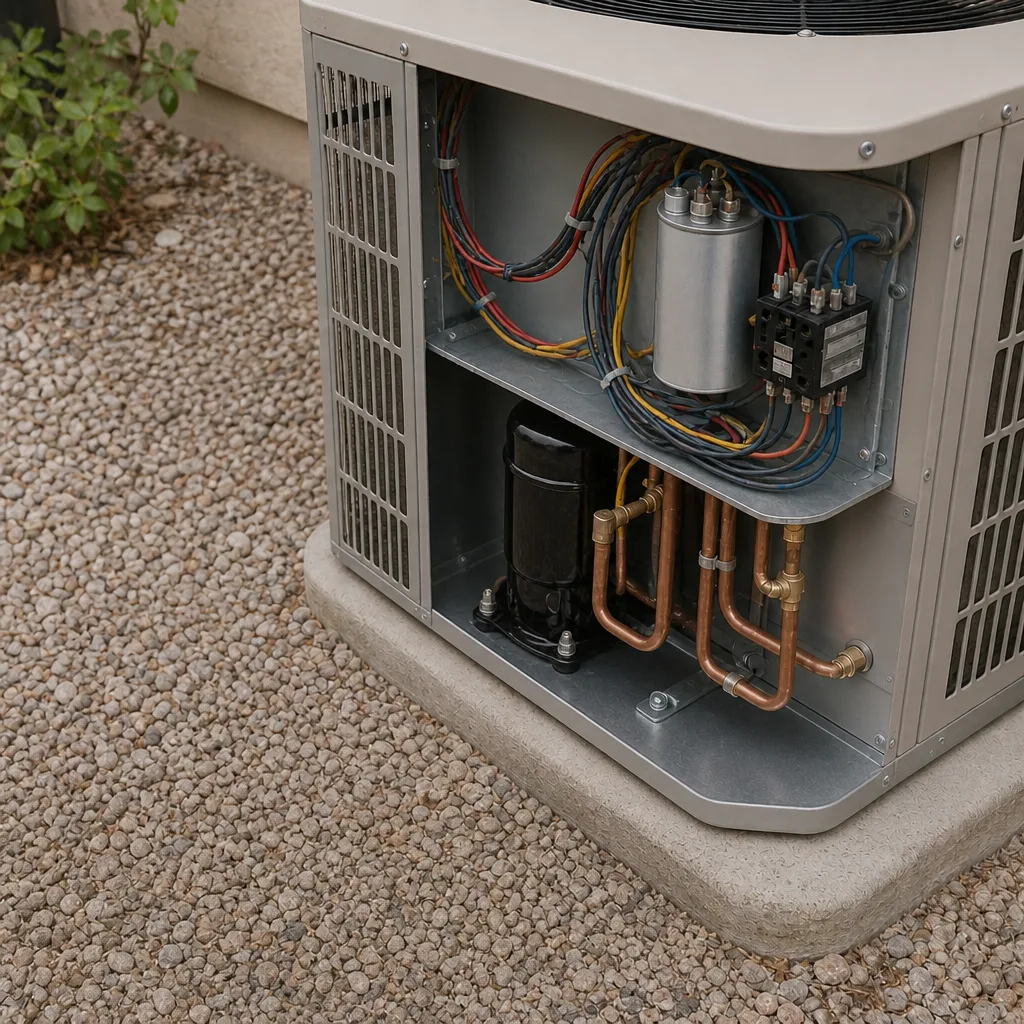 After
Why the Same Symptom Has Different Causes in a Desert Climate
This is the part most guides skip. Air conditioning doesn’t fail in a vacuum – it fails in the context of the environment it’s running in. Mesquite’s climate produces a specific set of operating conditions that shape which component fails first.
Long cooling seasons mean the system runs more hours per year than in a milder climate. More runtime means the compressor, capacitor, and contactor accumulate wear faster. Dust and windblown debris load the condenser coil and the filter faster. Temperature swings between a 110°F afternoon and a 70°F night stress the system’s pressure differentials. And the shoulder-season transition – when daytime high pressure but nighttime lows fall into the 70s – is when slow refrigerant leaks and control failures first show themselves.
In our experience, a homeowner who reports “it was fine until last week” in July is telling us a pressure or heat-rejection problem has finally crossed a threshold. The same homeowner in March is telling us a leak or control issue has crossed a threshold. Same words, entirely different diagnosis. Our technicians have up to 10 years of experience with the failure patterns these systems develop in summer heat, and the brands we service – Daikin, Bryant, Carrier, and six others – each have their own known weak points.
The practical takeaway: describe the symptom and the season it appeared in. If the problem shows up in July after months of running fine, note that. If it shows up in March after winter idle, note that too. That single detail reframes the diagnosis.
Brand-Specific Considerations for Mesquite Homes
Not every system fails the same way. The nine major brands we service have characteristic weak points, and knowing which brand you have helps a technician come prepared.
- Daikin and Bryant: Reliable but sensitive to low charge; ice and short cycling in summer often trace to leaks at the Schrader valves or flare fittings.
- Carrier and American Standard: Strong heat-rejection performance, but the capacitor and contactor are the usual failure points on no-start calls.
- Goodman, Rheem, and York: Common in value-built homes; blower motors and control boards are frequent repair items.
- Trane and Lennox: Durable compressors, but sensitive to dirty condenser coils. A coil cleaning goes a long way.
We work on nearly every major brand, so the diagnosis starts with your system, not with a sales pitch for a different one. For homeowners weighing repair against replacement, our AC replacement Mesquite specialists can run the numbers honestly – repair cost, remaining life, and efficiency – so the decision is based on the system, not the sale.
How to Distinguish Refrigerant, Airflow, and Electrical Issues Without Tools
Most diagnostic guides assume you have gauges and a multimeter. You don’t need either to narrow the problem to one of three categories. Here’s the decision tree we use to triage calls before we arrive.
Step 1: Is air moving?
Put your hand over a supply register. If air is moving but it’s room temperature, you’re looking at a refrigerant or compressor problem. If air is barely moving, it’s airflow or blower. If air isn’t moving at all, the indoor blower or the system power is the issue.
Step 2: Is the outdoor unit running?
Listen at the outdoor unit. If the fan is spinning and you hear the compressor humming, the system is running but not cooling – refrigerant leak, low charge, or a failed compressor. If the fan runs but the compressor doesn’t, that’s electrical – capacitor or contactor. If nothing runs, check the breaker and the thermostat.
Step 3: Is there ice?
Ice on the copper lines or indoor coil points to low refrigerant or restricted airflow. Shut the system down, thaw it fully, and check the filter before calling.
Step 4: What does the thermostat say?
Error codes on the thermostat display are a shortcut. Note the code and the brand. Not every code points to the same fault across manufacturers, but it gives the technician a starting point.
Common Mistakes to Avoid
- Repeatedly resetting the breaker without diagnosing the trip. If a breaker trips more than twice, stop. You’re stressing the compressor and possibly masking a failing component or a short.
- Running the system with visible ice on the coil. It’s tempting to “see if it’ll fix itself.” It won’t. Ice means the underlying airflow or charge problem is still there, and running it can damage the compressor.
- Adding refrigerant yourself from a can. Refrigerant is regulated, and adding charge without diagnosing the leak is like topping off a tire with a nail in it. The leak wins.
- Assuming a dirty filter is the only airflow cause. Filters are the easy win, but blocked returns, a dirty coil, and disconnected ducts cause the same symptom. If airflow doesn’t improve after a filter change, look further.
- Moving the thermostat up and down to “reset” the system. Rapid switching stresses the compressor and control board. If the system is misbehaving, leave it alone and call.
- Waiting through “just one more week” when you smell burning or hear grinding. Those two symptoms are the signs of a component actively failing. The repair is cheaper before the compressor goes.
- Choosing a technician based only on the lowest diagnostic quote. Diagnostic quality is the whole game in AC repair. A cheap call that misses the real cause costs twice.
When to Call a Professional
Call a professional when any of these situations is true: the breaker trips repeatedly, you smell burning or hear grinding, the coil is frozen and won’t stay thawed after a filter change, the outdoor unit won’t start after the breaker and safety switch check out, water is leaking into the home, the system is short cycling and getting worse, or the system runs but never cools the house. Those require gauges, a multimeter, or refrigerant handling – tools and training most homeowners don’t have, and shouldn’t use on a live system. AC Replacement Mesquite offers free estimates in Mesquite – call (866) 764-5851. We answer 24/7. Fast dispatch from 7am to 7pm, Sunday through Friday. Tell us the symptom, the season it appeared, and the brand, and we’ll come prepared.
Frequently Asked Questions
Warm air usually means low refrigerant from a leak, a failed compressor, or restricted airflow. In Mesquite’s July heat, warm air often points to a heat-rejection or charge problem that’s been building since spring. Check the filter and returns first, then call if the air is still warm. Call (866) 764-5851 for an exact quote – estimates are free.
Yes. A dirty filter restricts airflow, which reduces cooling and can cause the evaporator coil to freeze. In dusty conditions, filters load up faster than the manufacturer’s interval suggests. Replace it and re-test. If airflow and cooling don’t improve, the cause is elsewhere. Call (866) 764-5851 and we’ll help you narrow it.
Repair makes sense when the system is otherwise healthy, the repair cost is reasonable relative to replacement, and you haven’t had repeat failures. Replacement makes sense when the compressor is failing, the system is leaking repeatedly, or repair costs approach replacement. We give an honest assessment first, not a sales pitch. Call (866) 764-5851 for a free estimate.
Most AC repairs land in the low-to-mid hundreds of dollars, with compressor or coil replacements costing more. The final price is set per job by the written estimate, so you know the number before we start. Diagnostic visits give you an accurate figure rather than a phone guess. Call (866) 764-5851 – estimates are free.
Yes, same-day service is available for many repairs. We answer 24/7, and fast dispatch runs from 7am to 7pm, Sunday through Friday. A call outside those hours gets booked into the next opening, Sunday through Friday, 7am to 7pm. Call (866) 764-5851 and describe the symptom.
We service nine major brands: Carrier, Trane, Lennox, Goodman, Rheem, York, Daikin, Bryant, and American Standard. That covers nearly every system a Mesquite homeowner is likely to have installed. We’re brand-neutral, so the recommendation follows your system and budget. Call (866) 764-5851.
Have the brand, approximate system age, the symptom (warm air, weak air, noise, won’t start), the season it first appeared, what you’ve already checked (filter, breaker, thermostat), and whether there’s ice or water. That information shortens the diagnostic visit and makes the estimate more accurate. Call (866) 764-5851.
The Bottom Line
AC troubleshooting starts with what you actually notice, not with a component list. Warm air, weak air, no-start, strange sounds, short cycling, and ice each point to a small set of likely causes – and in Mesquite’s desert climate, the season the symptom appears changes which cause is most likely. Do the safe checks first: thermostat, breaker, filter, returns, drain pan, outdoor clearance. Then call for the rest. Our technicians have up to 10 years of experience, we service nine major brands, and AC is all we do. Call (866) 764-5851 for a free estimate. We answer 24/7, with fast dispatch from 7am to 7pm, Sunday through Friday.
Written by the team at AC Replacement Mesquite.